

 Facebook
 X
X
 Pinterest
 Copy Link
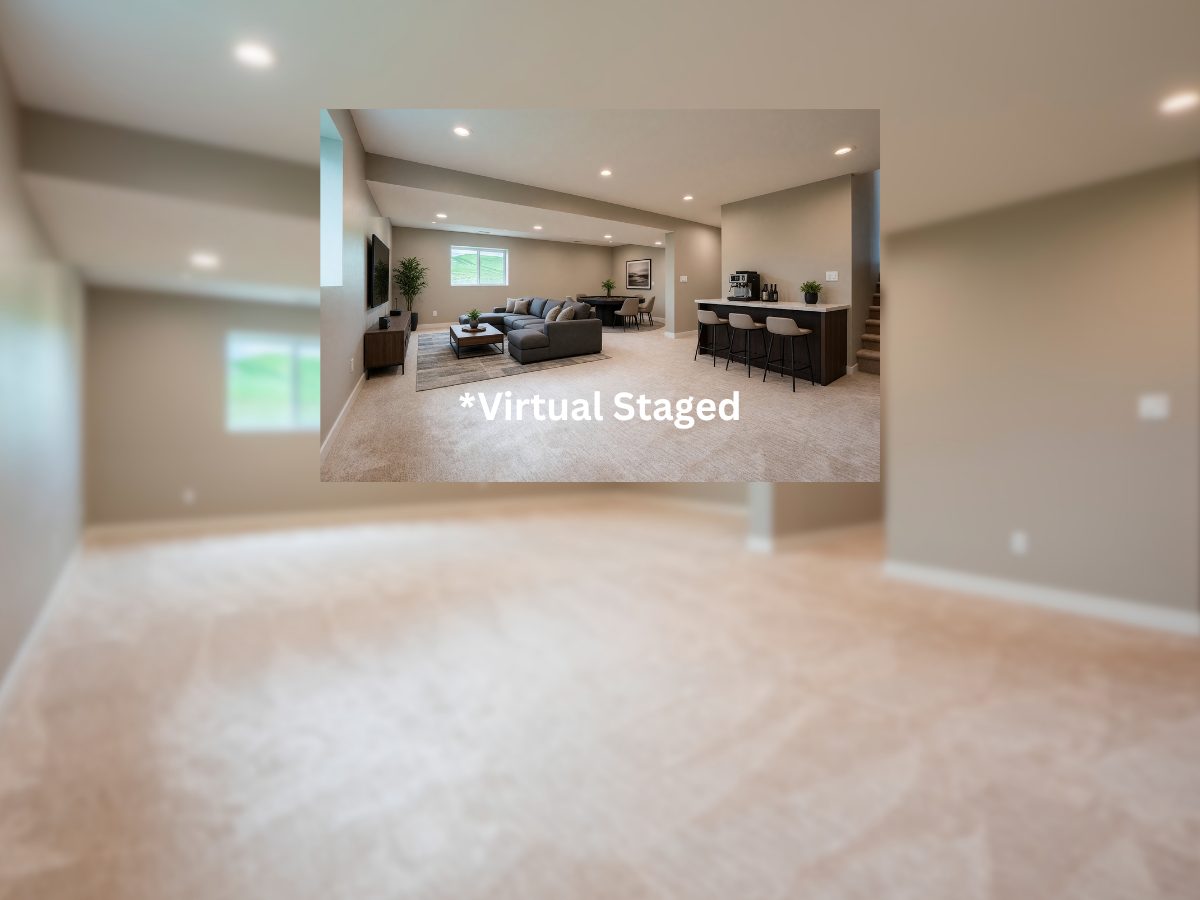
If you’ve ever walked into an empty room and thought, “Okay…but what would I actually do with this space?” you’re not alone.
Empty rooms can be surprisingly difficult to picture.
That’s one of the reasons I recently used virtual staging photos for my new construction listing at 1912 2nd Ave SE in Le Mars. The home is finished and ready for its first owner, but without furniture, some of those nice, open spaces can be harder to visualize in photos.
Virtual staging gave me a way to show some possibilities while still letting buyers see the actual home.
What Are Virtual Staging Photos?
Virtual staging is pretty much what it sounds like. Instead of physically bringing furniture, rugs, artwork, tables and décor into a vacant home, those items are digitally added to a photograph.
The actual room is still there. The walls, windows, flooring and layout aren’t being replaced. We’re simply adding furnishings to help give the room some perspective.
And I think that last part is important.
Virtual staging photos should be clearly identified as virtually staged. Buyers should know when they’re looking at a representation of how a room could look rather than what will actually be there when they walk through the door.
Virtual Staging Photos Help Show Scale
Have you ever looked at a photo of an empty bedroom and wondered whether a king-size bed would fit?
Or looked at a large open basement and had absolutely no idea where you’d put the furniture?
Without familiar objects in a room, it can be difficult to judge its size.
Adding a sofa, coffee table, dining table or other furnishings can help your eye understand the scale of the room. Suddenly, that big open area starts making a little more sense.
That can be especially helpful with new construction because the entire home may be empty.
One Room Can Have More Than One Purpose
This was probably my favorite part of virtually staging the lower level at 1912 2nd Ave SE.
It’s a BIG family room.
I could tell you that you could use it for entertaining, movies, games, a home gym or several things at once. But sometimes it’s easier to understand when you can actually see it.
So we tried different ideas.
One version shows a comfortable family room with an additional gathering area. Another turns more of the space into a game room with a pool table and arcade games.
Neither one is telling a buyer, “This is what you should do.”
It’s really the opposite.
It’s saying, “Look at what you COULD do.”
Someone else might walk in and immediately see a workout area, craft space, play area, home office or something I never would have thought of.
That’s part of the fun.
Why Not Just Physically Stage the Home?
Traditional staging can be wonderful, but it also means moving furniture and décor into a property, setting everything up, maintaining it while the home is listed and eventually moving everything back out.
For a vacant new construction home, virtual staging can be a practical alternative.
We can keep the home clean and completely open for showings while using the listing photos to give buyers a few ideas about how those empty rooms could function.
And when someone comes for a showing, they get to see the real space without furniture blocking anything.
Virtual Staging Shouldn’t Replace Reality
This is the part I feel strongly about.
Virtual staging should help buyers visualize a property, not mislead them about the property.
If something is digitally added to a photo, buyers should know it.
That’s why I include a disclosure explaining that the photos have been virtually staged and that the furnishings, décor and other digitally added items are not included with the property.
I also want buyers to have access to photos showing the home’s actual condition.
There’s a big difference between helping someone imagine a sofa in a room and digitally changing something about the property itself.
Sometimes You Just Need a Little Imagination
Real estate photos have an interesting job.
They need to show you what’s actually there, but they also need to help you picture what life might look like in that space.
That can be harder when you’re looking at four empty walls.
For me, virtual staging photos are another tool I can use to help buyers better understand a home before they ever schedule a showing.
And with a new construction property like 1912 2nd Ave SE, it has been fun trying out different ideas.
Of course, the best way to figure out what you would do with all that space is to come see the real thing.
The virtual furniture may disappear when you walk through the door, but you might be surprised how quickly your own ideas start filling the room.
📱 Julie Hurt
712-540-7757


